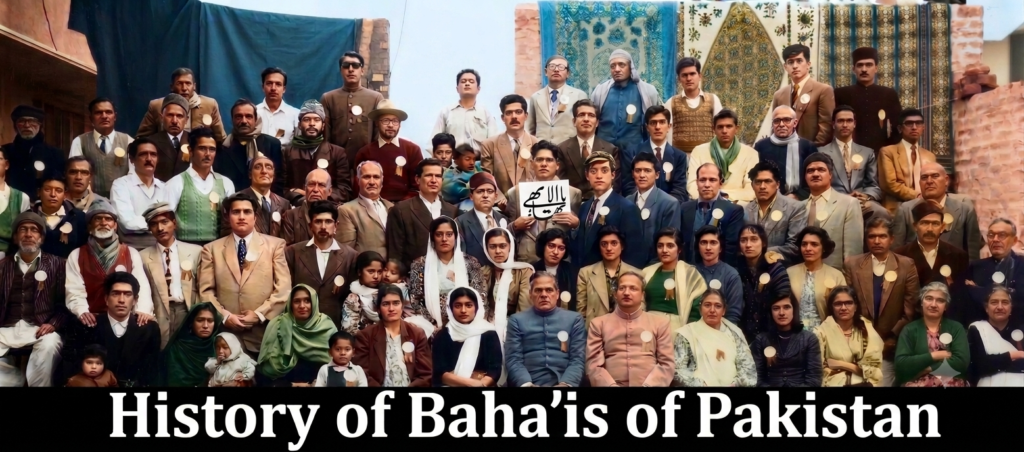
History of Baha’is of Pakistan
The Bahá’í Faith first spread its light to the region of present-day Pakistan in the early nineteenth century, when Saeed-i-Hindi of Multan became one of the earliest souls to embrace the Message of Bahá’u’lláh. Since then, the Bahá’ís of Pakistan have sought to embody the timeless teachings of unity, justice, and service to humanity. They see themselves as humble participants in Bahá’u’lláh’s call for the construction of a divine world civilization—one founded on spiritual principles and expressed through acts of service to the common good.
From its inception, the Bahá’í community in Pakistan has been animated by a spirit of devotion and a commitment to uplift society. The community’s contributions have spanned decades and fields, ranging from education to health, and interfaith dialogue. One of its earliest social initiatives emerged in the late 1970s, when the Bahá’ís of Karachi established a Montessori school that would later grow into the New Day Secondary School, providing generations of children with a nurturing and value-based education.
Over the years, the Bahá’ís of Pakistan have worked alongside individuals, communities, and institutions—governmental and non-governmental—to advance the well-being of all. They have organized literacy programs in rural areas, free medical camps, tree plantations, and national seminars on coexistence and moral development. Deeply conscious of the oneness of humanity, Bahá’ís have also taken part in interfaith dialogues and collaborative initiatives with members of every religion and background, seeking to build bridges of understanding and unity.
At the heart of Bahá’í community life are its community-building activities, which invite people from all walks of life to come together in a spirit of fellowship and learning. Across Pakistan, in cities, towns, and villages, Bahá’ís and their friends are establishing a pattern of life centered on service, consultation, and prayer. Small groups gather regularly to study the Word of God, reflect on its application to daily life, and take collective action for the betterment of their surroundings. These efforts are helping to raise the capacity of individuals and communities to contribute to the spiritual and social advancement of their society.
Particular attention is given to the spiritual empowerment of children and youth. Classes for children nurture qualities such as kindness, honesty, and cooperation, while junior youth groups help adolescents develop the moral clarity and purpose needed to make constructive choices and contribute meaningfully to their communities. As youth arise to serve, they are described by Bahá’u’lláh as “mines rich in gems of inestimable value,” discovering their inner potential and using it for the upliftment of others. Many young people, moved by a sense of responsibility, have initiated small projects—cleaning their neighborhoods, teaching younger children, planting trees, and promoting education—thus giving tangible expression to their faith through service.
In every endeavor, the Bahá’ís of Pakistan strive to foster environments of unity and learning, where people are empowered to think deeply about the conditions of their society and to act with compassion and wisdom. In homes, community centers, and rural fields, one finds gatherings filled with reverence, joy, and purpose—where prayers are recited and hearts are kindled with the love of God and the desire to serve humanity.
Through these ever-expanding efforts, the Bahá’í community of Pakistan, diverse yet united in purpose, continues to contribute to the material and spiritual prosperity of its nation. Its members believe that true progress arises when individuals, families, and institutions work hand in hand—guided by the principles of unity, justice, and service—to build a civilization that mirrors the oneness of humankind.